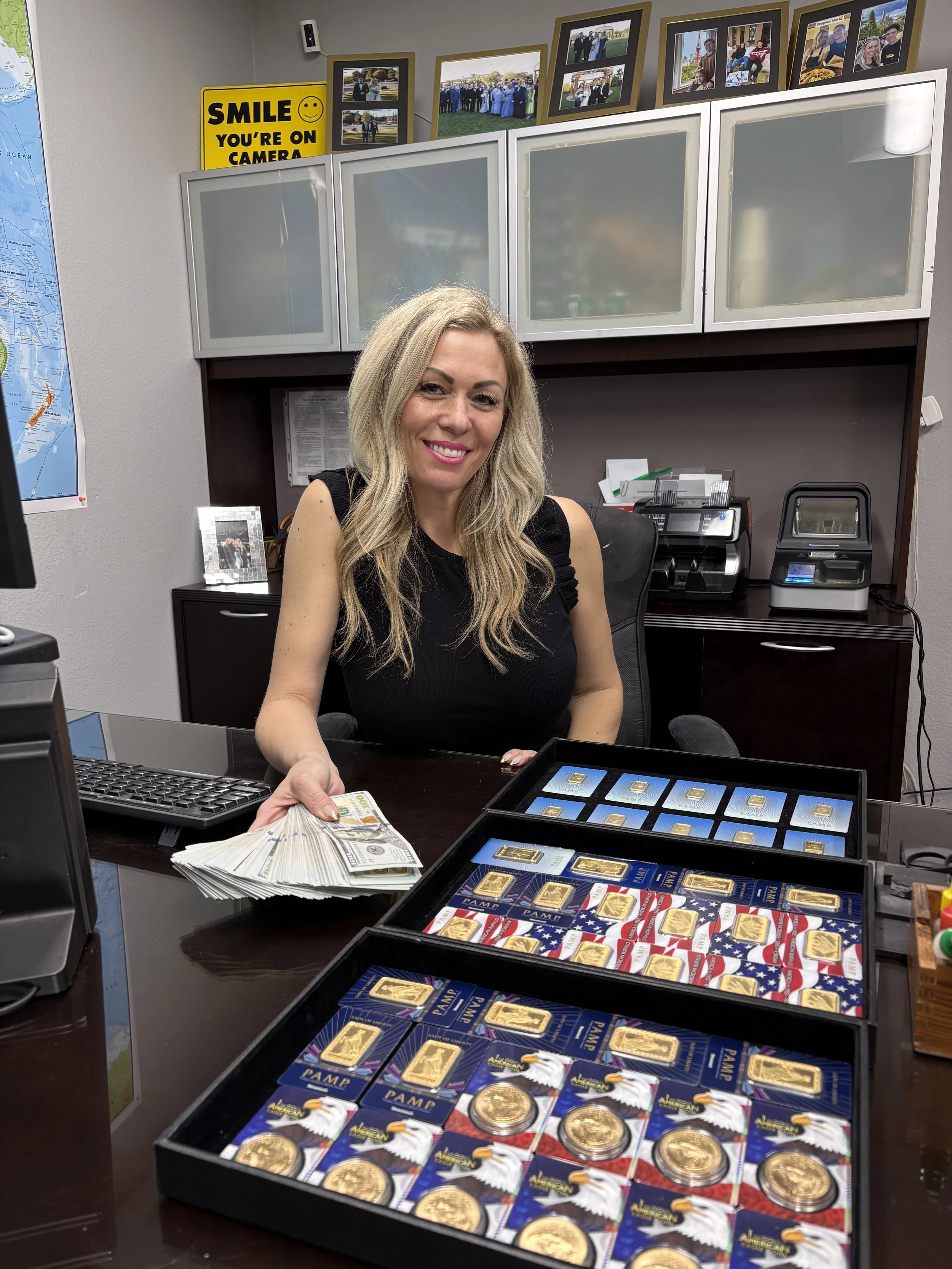
The Ultimate Orange County Gold Selling Guide
Everything You Need to Know Before Selling Gold Jewelry, Coins, Bullion, Sterling Silver & Luxury Watches
Introduction
If you're thinking about selling gold, you're probably asking one simple question:
"Where do I start?"
Whether you've inherited an estate, cleaned out a jewelry box, invested in gold bullion years ago, or simply have broken jewelry collecting dust, selling precious metals is often something people only do once or twice in their lifetime.
Because of that, it's completely normal to have questions.
How much is my gold worth?
How is gold tested?
Should I sell now or wait?
Should I compare more than one buyer?
What if my jewelry has diamonds?
Does broken jewelry still have value?
Can I sell a single earring?
How long does everything take?
These are all excellent questions.
Over the past 23+ years, we've helped thousands of Orange County residents evaluate gold jewelry, coins, bullion, sterling silver, platinum, luxury watches and estate collections. Along the way, we've noticed something important:
The people who have the best experience aren't necessarily the people who know the most about gold.
They're the people who ask questions.
This guide was created to answer those questions.
Rather than simply explaining how Glitter Bug Gold Buyers works, our goal is to educate you about the entire gold-selling process so you can make informed decisions with confidence.
Whether you ultimately choose to sell today, wait until later, or simply want to understand what you own, we hope this guide becomes your trusted resource.
Table of Contents
Why People Sell Gold
What Types of Precious Metals Can Be Sold?
Understanding Gold Purity
What Determines Gold Value?
How Professional Gold Buyers Test Gold
Understanding Spot Price
Why Two Gold Buyers May Offer Different Amounts
Should You Compare Multiple Gold Buyers?
Common Mistakes Sellers Make
Selling Estate Jewelry
Selling Inherited Jewelry
Selling Gold Coins
Selling Gold Bullion
Selling Sterling Silver
Selling Luxury Watches
Selling Dental Gold
High-Karat International Gold
Frequently Asked Questions
Why Orange County Residents Choose Glitter Bug Gold Buyers
Chapter 1
Why Do People Sell Gold?
People sell precious metals for many different reasons.
Some are practical.
Some are financial.
Others are deeply personal.
There isn't one "right" reason to sell gold, and every customer's situation is unique.
Some of the most common reasons include:
Inherited Jewelry
Many families inherit jewelry that no one wears. Rather than leaving valuable items sitting in a safe or drawer for years, some people choose to have them evaluated and decide whether selling makes sense.
Broken Jewelry
Broken chains.
Single earrings.
Bent rings.
Damaged bracelets.
Clasps that no longer work.
Although these pieces may no longer be wearable, they can still contain valuable precious metals.
Outdated Jewelry
Styles change over time.
Jewelry that was popular decades ago may no longer match someone's personal style.
Many people decide to sell pieces they haven't worn in years.
Estate Liquidation
Executors and families often need to evaluate jewelry collections during estate administration.
Professional evaluations can help determine what items are made of and assist with informed decisions about whether to keep, distribute, or sell them.
Gold Bullion Investments
Some investors purchase gold bullion as a long-term store of value.
Eventually, they may decide to liquidate part or all of their holdings depending on their financial goals or changing market conditions.
Sterling Silver Collections
Many households own sterling silver flatware, serving trays, tea sets, bowls, candle holders, and other decorative pieces that are rarely used today.
These collections may have precious metal value and are often brought in for evaluation.
Luxury Watches
Rolex, Cartier, Omega, Breitling, Patek Philippe, Audemars Piguet, and other luxury watches are frequently evaluated by people looking to upgrade, simplify a collection, or liquidate assets.
Life Changes
Customers also visit us because of:
Downsizing
Retirement
Divorce
Relocation
Paying off debt
Medical expenses
College tuition
Major purchases
Simplifying their estate
Reducing unused valuables
Every situation is different.
Regardless of the reason, understanding the process helps you make better decisions.
Why Education Matters More Than Ever
Selling gold isn't something most people do regularly.
That's why misinformation is common.
Some people believe:
All gold is worth the same.
Broken jewelry has no value.
Gold buyers all pay exactly the same.
Spot price equals what every item is worth.
Diamonds always add significant value.
Cleaning jewelry increases its value.
In reality, every item is unique, and many factors influence an evaluation.
The more you understand before visiting a gold buyer, the more confident you'll feel throughout the process.
Chapter 2
What Types of Precious Metals Can Be Sold?
One of the most common misconceptions is that only traditional gold jewelry has value.
In reality, professional gold buyers evaluate a wide variety of precious metal items. Many customers are surprised to learn that items tucked away in drawers, safety deposit boxes, inherited estates, or old collections may contain valuable precious metals.
Below are some of the most common categories.
Gold Jewelry
Gold jewelry remains the most common category brought in for evaluation.
Examples include:
Gold necklaces
Gold chains
Bracelets
Rings
Wedding bands
Engagement rings
Earrings
Pendants
Charms
Anklets
Lockets
Brooches
Pins
Tie tacks
Cufflinks
Many people also bring in broken or outdated jewelry that is no longer worn but may still contain valuable precious metals.
Broken Gold Jewelry
A common question is:
"Is broken gold still worth anything?"
The answer is often yes.
Items such as:
Broken chains
Bent rings
Single earrings
Broken bracelets
Damaged necklaces
Missing clasps
Scrap gold
Tangled jewelry
may still contain valuable precious metal.
Because the evaluation is based on the metal itself rather than whether the jewelry is wearable, damaged pieces may still have value.
Gold Coins
Many collectors and investors own gold coins.
Common examples include:
American Gold Eagles
Canadian Maple Leafs
South African Krugerrands
American Gold Buffalos
Austrian Philharmonics
Chinese Pandas
Mexican Gold Pesos
British Sovereigns
Saint-Gaudens Double Eagles
Liberty Gold Coins
Commemorative Gold Coins
Some coins are evaluated primarily for their precious metal content, while others may also have collectible or numismatic value.
Gold Bullion
Investment bullion is another common category.
Examples include:
Gold bars
Minted bars
Cast bars
Gold rounds
Fractional gold bars
Kilobars
One-ounce bars
Multi-ounce bars
Bullion products are typically manufactured by recognized private or government mints and are commonly purchased by investors seeking exposure to precious metals.
Sterling Silver
Many households contain sterling silver without realizing it.
Common examples include:
Flatware
Serving trays
Tea sets
Bowls
Pitchers
Candle holders
Serving utensils
Coffee sets
Hollowware
Jewelry
Decorative pieces
Sterling silver is commonly marked "925" or "Sterling," although not every genuine piece is clearly marked.
Silver Bullion
Silver investors frequently own:
American Silver Eagles
Canadian Silver Maple Leafs
Silver bars
Silver rounds
Junk silver coins
Constitutional silver
Collectible silver bullion
Like gold bullion, these items are evaluated differently from ordinary jewelry.
Platinum Jewelry
Although less common than gold, platinum jewelry is regularly evaluated.
Examples include:
Engagement rings
Wedding bands
Necklaces
Earrings
Bracelets
Pendants
Platinum is a different precious metal than white gold and requires its own evaluation.
Dental Gold
Many people are surprised to learn that dental gold may contain valuable precious metals.
Examples include:
Crowns
Bridges
Inlays
Onlays
Dental scrap
Older dental restorations
The precious metal content can vary, which is why professional testing is important.
Luxury Watches
Luxury watches are another category that many professional buyers evaluate.
Common brands include:
Rolex
Cartier
Omega
Breitling
TAG Heuer
Tudor
Panerai
Patek Philippe
Audemars Piguet
Jaeger-LeCoultre
The value of a luxury watch depends on many factors beyond the precious metal, including the model, condition, originality, and accompanying accessories.
Estate Jewelry
Estate jewelry often includes a mixture of:
Gold
Platinum
Diamonds
Gemstones
Antique pieces
Vintage jewelry
Designer jewelry
Because every estate collection is unique, each piece should be evaluated individually.
Inherited Jewelry
Many Orange County families inherit jewelry from parents, grandparents, or other relatives.
Often, people don't know:
whether it's real gold
what karat it is
whether gemstones add value
whether pieces are collectible
whether they should sell or keep them
A professional evaluation can help identify what you have and explain the characteristics of each item.
Can You Sell Just One Item?
Absolutely.
Many customers believe they need a large collection before visiting a gold buyer.
That isn't the case.
People frequently bring in:
One ring
One bracelet
One broken chain
One gold coin
One watch
One sterling silver serving tray
One inherited necklace
Every evaluation is different, whether it's a single item or an entire estate.
Can You Sell Mixed Precious Metals?
Yes.
Many customers bring in collections containing:
Gold
Silver
Platinum
Coins
Bullion
Watches
Sterling silver
Estate jewelry
Professional buyers typically sort and evaluate each category separately so that each item can be assessed appropriately.
Chapter 3
Understanding Gold Purity
One of the biggest factors affecting the value of gold jewelry is its purity.
Not all gold jewelry contains the same amount of pure gold.
That's why professional testing is an important part of the evaluation process.
What Does "Karat" Mean?
Karat (K) measures the percentage of pure gold contained in an item.
Common purities include:
10K Gold
Contains approximately 41.7% pure gold.
Because of its durability, 10K is commonly used in everyday jewelry.
14K Gold
Contains approximately 58.3% pure gold.
This is one of the most common purities found in American jewelry.
It offers a balance between durability and precious metal content.
18K Gold
Contains approximately 75% pure gold.
Often found in higher-end jewelry, luxury brands, and fine designer pieces.
22K Gold
Contains approximately 91.6% pure gold.
This purity is common in many cultures around the world, particularly in traditional wedding jewelry and investment jewelry.
Because of its high gold content, 22K jewelry is softer than lower-karat alloys.
24K Gold
Contains approximately 99.9% pure gold.
Pure gold is most commonly found in investment bullion, coins, and bars rather than everyday jewelry because it is relatively soft.
Why Purity Matters
Imagine two bracelets that look nearly identical.
One is 10K.
The other is 18K.
Although they may appear similar, they contain different amounts of pure gold. That difference can significantly affect their precious metal value, assuming similar weight.
However, purity is only one part of the evaluation. Weight, market conditions, craftsmanship, and, in some cases, collectible value may also influence how an item is assessed.
Can Hallmarks Be Wrong?
Many pieces are stamped with hallmarks such as:
10K
14K
18K
22K
24K
417
585
750
916
999
Hallmarks are useful, but they are not the only factor professionals consider. Marks can wear down over time, be difficult to read, or, in some cases, appear on items that require additional verification.
That's why professional evaluation may involve more than simply reading the stamp.
Chapter 4
How Professional Gold Buyers Evaluate Gold Jewelry
Many first-time sellers assume evaluating gold is as simple as placing it on a scale.
In reality, a professional evaluation involves several steps. While each business may have its own process, experienced gold buyers generally consider multiple factors before making an offer.
Understanding these factors helps explain why two pieces of jewelry that look similar can have very different values.
Step 1: Identify the Precious Metal
The first step is determining exactly what the item is made from.
A collection may include:
Gold
Sterling silver
Platinum
Palladium
Mixed-metal jewelry
Gold-filled jewelry
Gold-plated jewelry
Costume jewelry
At first glance, many of these materials can look alike. Professional testing helps identify the actual metal composition.
Step 2: Verify Gold Purity
Once an item has been identified as gold, the next step is determining its purity.
Professional buyers commonly verify whether an item is:
10K
14K
18K
22K
24K
Different purities contain different percentages of pure gold, which is one of the factors that influences value.
Step 3: Separate Items by Karat
A jewelry box often contains a mixture of different purities.
For example:
One ring may be 10K.
A bracelet may be 14K.
A necklace may be 18K.
A wedding band may be 22K.
Separating items by purity helps ensure each group is evaluated appropriately rather than treating the entire collection as though it were all the same karat.
Step 4: Weigh the Precious Metal
After purity has been identified, the items are weighed using a certified jewelry scale.
Weight is one of the key factors used during an evaluation.
Even small differences in weight can affect the amount of precious metal contained in an item.
Step 5: Evaluate Special Items
Not every item is valued solely for its precious metal content.
Examples include:
Designer jewelry
Vintage jewelry
Estate jewelry
Luxury watches
Rare coins
Investment bullion
Antique pieces
These items may require additional consideration beyond the precious metal itself.
Step 6: Explain the Evaluation
One of the most important parts of the process is communication.
A professional evaluation should help you understand:
What the item is
How it was tested
Its purity
Its weight
Any unique characteristics
How the evaluation was determined
The more you understand, the more confident you'll feel.
Chapter 5
Why Can Two Gold Buyers Make Different Offers?
One of the questions we hear most often is:
"Why did I receive two different offers?"
There isn't always a single reason.
Several factors may contribute to differences in evaluations.
Different Business Models
Businesses may specialize in different areas.
Some focus primarily on jewelry.
Others regularly handle:
Bullion
Coins
Estate jewelry
Luxury watches
Sterling silver
Antique pieces
A buyer's specialty can influence how they evaluate certain items.
Market Conditions
Gold prices change throughout the day.
If evaluations occur at different times, changing market conditions may influence offers.
Different Item Classifications
One buyer may identify collectible characteristics that another buyer does not.
Likewise, some items may be evaluated primarily for their precious metal content, while others may receive additional consideration because of their collectible or designer appeal.
Communication
Sometimes the biggest difference isn't the offer itself.
It's understanding how the evaluation was performed.
Many customers appreciate having the testing process explained and the opportunity to ask questions.
Chapter 6
Understanding Gold Spot Price
One of the most misunderstood concepts in precious metals is the spot price of gold.
Spot price refers to the current market price for raw, unfabricated gold traded on global commodities markets.
It serves as an important reference point, but it is not automatically the amount someone receives for every gold item.
Why Doesn't Every Item Equal Spot Price?
Finished jewelry is different from raw investment-grade gold.
An evaluation may take into account factors such as:
Purity
Weight
Refining requirements
Manufacturing alloys
Market conditions
Item type
Understanding the difference between spot price and the evaluation of finished jewelry helps set realistic expectations.
Does Spot Price Change?
Yes.
Gold trades globally, and prices fluctuate throughout the trading day.
Because of this, evaluations may also change as market conditions change.
Chapter 7
How Modern Gold Testing Works
Professional testing is designed to help identify the composition of precious metals.
Different buyers may use different testing methods, and some may use more than one method depending on the item being evaluated.
Common methods include:
Hallmark inspection
XRF analysis
Electronic precious-metal testing
Acid testing
Density testing
Magnet testing
Visual inspection
Each method has its own purpose and may be used as part of the overall evaluation.
What Is XRF Technology?
XRF stands for X-ray fluorescence.
This technology analyzes the elemental composition of a metal without cutting into or damaging many items.
At Glitter Bug Gold Buyers, we use a Thermo Scientific™ Niton™ XRF Precious Metals Analyzer to evaluate many precious-metal items.
Customers can observe the testing process and ask questions about the results.
Why Do Buyers Use More Than One Testing Method?
Different items present different challenges.
For example:
Worn hallmarks
Mixed-metal construction
Antique jewelry
White gold
High-karat international jewelry
Unmarked pieces
Using more than one method, when appropriate, can help provide a more complete evaluation.
Chapter 8
Common Misconceptions About Selling Gold
There are many myths surrounding precious metals.
Here are a few of the most common.
Myth: Broken jewelry isn't worth anything.
Reality: Many broken gold items still contain valuable precious metals.
Myth: All gold is the same.
Reality: Gold purity, weight, craftsmanship, and market conditions all play a role in an evaluation.
Myth: Every buyer evaluates jewelry exactly the same way.
Reality: Businesses may use different testing methods, specialize in different types of items, or explain their evaluations differently.
Myth: Cleaning jewelry increases its value.
Reality: Cleaning generally does not increase the precious metal content of an item.
Myth: You need a large collection to visit a gold buyer.
Reality: Many customers bring in a single ring, bracelet, necklace, coin, or watch for evaluation.
Chapter 9
25 Questions Every Gold Seller Should Ask Before Accepting an Offer
One of the best ways to feel confident about selling your gold is to ask questions. A professional gold buyer should be happy to explain the evaluation process so you understand how your items are being assessed.
Consider asking:
How will my gold be tested?
Can I watch the testing process?
How do you determine the karat?
Are different karats separated before being weighed?
How do you identify unmarked jewelry?
Are gemstones evaluated?
How are gold coins different from jewelry?
How is bullion evaluated?
How do you determine the purity of sterling silver?
Can broken jewelry still have value?
Does the condition of my jewelry affect the evaluation?
How is platinum identified?
Can dental gold be evaluated?
What happens if I'm unsure what an item is made of?
Can I ask questions during the evaluation?
How long does the process usually take?
Do I need an appointment?
Can I bring an inherited collection?
Can I bring multiple types of precious metals?
What if I decide not to sell?
How do market prices affect evaluations?
Should I compare more than one buyer?
What documents should I bring?
How will I be paid if I decide to sell?
Is there any obligation after receiving an evaluation?
Understanding the answers to these questions can help you make a well-informed decision.
Chapter 10
A Simple Checklist Before Selling Your Gold
Before visiting a gold buyer, consider the following checklist:
✓ Gather all of your gold, silver, platinum, coins, bullion, and watches.
✓ Leave broken jewelry together rather than trying to repair it.
✓ Separate sentimental items you may want to keep.
✓ Bring any boxes, certificates, or paperwork for luxury watches or bullion if you have them.
✓ Write down any questions you want answered.
✓ Allow enough time for a thorough evaluation.
✓ If you're comparing evaluations, bring the same collection to each business.
✓ Choose a business where you feel comfortable asking questions.
Frequently Asked Questions
Is there a fee for a gold evaluation?
Many professional gold buyers, including Glitter Bug Gold Buyers, offer free, no-obligation evaluations. Always confirm this with the business before your visit.
Do I need to clean my jewelry first?
No. Cleaning generally does not increase the precious metal content of your jewelry and may not affect the evaluation.
Can I sell one gold earring?
Yes. Even a single earring may contain valuable precious metal.
Can I sell broken jewelry?
Yes. Broken jewelry, damaged chains, bent rings, and single earrings may still have value based on their precious metal content.
Can I sell inherited jewelry?
Absolutely. Many customers bring inherited jewelry in simply to learn more about what they have before deciding whether to keep or sell it.
Can I sell gold coins?
Yes. Many gold buyers evaluate investment bullion and gold coins in addition to jewelry.
Can I sell sterling silver?
Yes. Sterling silver jewelry, flatware, tea sets, serving pieces, trays, bowls, and decorative items are commonly evaluated.
Can I sell luxury watches?
Many professional buyers evaluate luxury watches, including brands such as Rolex, Cartier, Omega, Breitling, Tudor, and others.
Should I compare more than one buyer?
Many experienced sellers choose to compare evaluations before making a decision. Comparing the same items and asking questions can help you better understand the process.
Why do different buyers sometimes make different offers?
Businesses may have different specialties, business models, testing methods, and evaluation processes. Understanding how your items were evaluated can help explain differences.
Why Orange County Residents Visit Glitter Bug Gold Buyers
For more than 23 years, Glitter Bug Gold Buyers has provided private, professional precious-metal evaluations for customers throughout Orange County.
Customers visit our offices to sell:
Gold jewelry
Gold coins
Gold bullion
Sterling silver
Platinum jewelry
Estate jewelry
Inherited jewelry
Dental gold
Luxury watches
Many customers appreciate:
Private office consultations
Live XRF precious metals testing
Family-owned business
BBB Accredited with an A+ Rating
More than 23 years serving Orange County
Friendly, educational, no-pressure environment
Immediate payment when a transaction is completed
Whether you're selling a single gold ring or an entire estate collection, our goal is to provide a transparent evaluation so you understand exactly what you have and how it is being assessed.
Visit Glitter Bug Gold Buyers
South Orange County Office
Glitter Bug Gold Buyers – Laguna Hills
23011 Moulton Parkway, Suite A-16
Laguna Hills, CA 92653
Phone: (949) 461-9191
North Orange County Office
Glitter Bug Gold Buyers – Anaheim Hills
155 North Riverview Drive, Suite 111
Anaheim Hills, CA 92808
Phone: (714) 409-9191